What Gabriel’s Horn Can Teach Us About Mathematics Education
I recently shared the paradox of Gabriel’s horn with my daughter. It is a nice mathematical object because the underlying idea is not especially difficult. The radius shrinks like 1/x. The volume is built from circular slices, whose areas shrink like 1/x², while the surface strips shrink only roughly like 1/x. One can therefore get a shape with finite volume but infinite surface area.
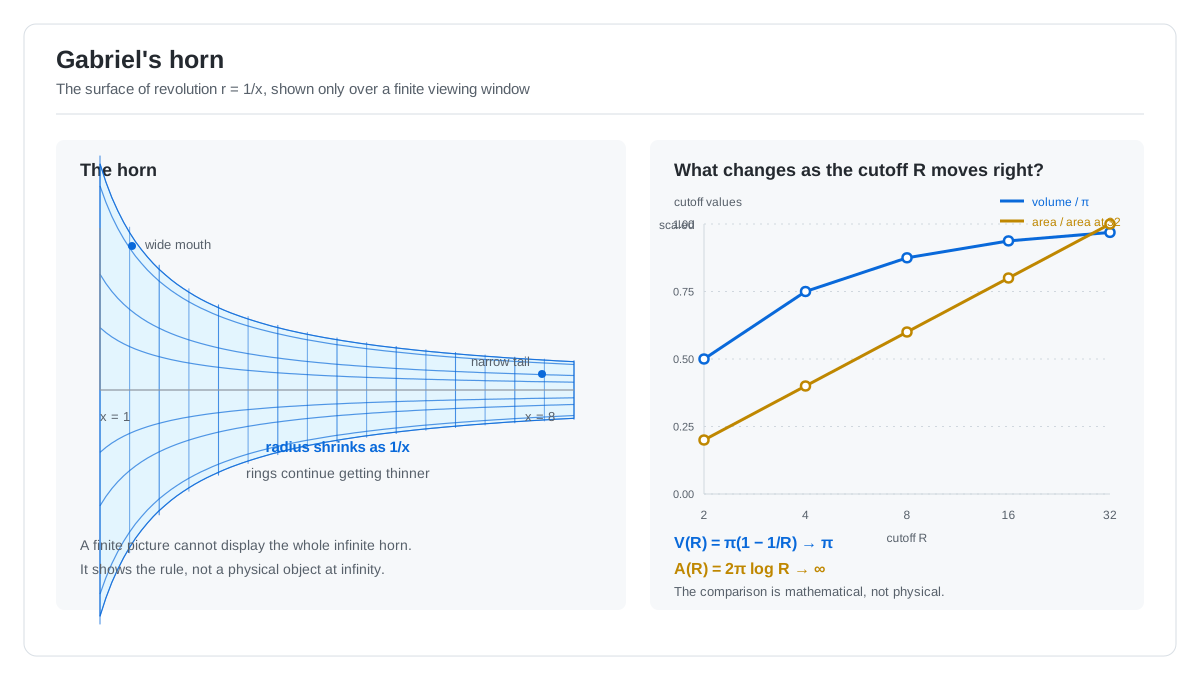
The famous paint idea follows from the same distinction. In the idealised mathematics, a finite amount of paint could fill the horn because its volume is finite. But painting the outside with any fixed positive thickness would require paint over an infinite surface area. That is a strange statement about limits in a mathematical model, not a claim that a real object, real paint, and real manufacturing process could be compared on those terms.
At a distance, this is probably high-school mathematics. The interesting part is not only deriving the result. It is what a student can do after understanding it.
That made me think about chess and Go. I played both a little when I was younger, and not very well. Looking back, my visual memory was not strong enough for deep calculation. But practice still taught me something valuable about learning. A competitive game can be broken into pattern recognition, intuition about a position, calculation, and repeated play. The student can see what to practise and get immediate feedback.
Mathematics can be taught in a similar way. Students need to recognise patterns, develop intuition about those patterns, and then think deeply about the consequences. School mathematics often stops once a result has been derived. The student learns the procedure, gets the answer, and moves on.
Gabriel’s horn offers a better kind of exercise. After learning the standard construction, a student could try to create other shapes with related scaling behaviour. What happens if the radius decreases at a different rate? Can the student find a shape whose volume is finite but whose area has another surprising property? Which parts of the argument change, and which remain the same?
Those questions turn a result into a playground. They ask a student to move from following a proof to designing a problem.
For stronger students, one or two hours of this kind of pattern-recognition practice may be more useful than another page of routine multiplication or differentiation. The point is not to make every lesson harder. It is to give students more chances to notice structure, make a conjecture, test it, and explain why it works.
Mathematics education should leave more room for that kind of work. A paradox such as Gabriel’s horn is valuable not because it is a clever fact, but because it invites the student to ask what else might be possible.
A mathematical reference on Gabriel’s horn gives the formal construction.