The mountain that fell into the sea
The mud floods along the Nepal-China border are difficult to look at. Roads, homes, bridges and lives can disappear under a moving wall of water, mud and rock. We feel the human cost because the disaster is happening now, to people whose names and faces we can see.
I keep thinking we need reminders of how much larger nature can be.
Around two million years ago, the northeastern flank of Koʻolau volcano on Oʻahu collapsed into the Pacific. The result was the Nuʻuanu debris avalanche, one of the largest known landslides on Earth. The debris travelled more than 200 kilometres across the ocean floor and spread over roughly 23,000 square kilometres.
The scale is hard to imagine until you look at the lumps left behind in the seabed. Tuscaloosa Seamount is thought to be one enormous block carried along by the slide. It measures about 24 by 16 kilometres and rises roughly 1.8 kilometres above the surrounding seafloor. That is a piece of an island, transported through the ocean.
The outlines of this wreckage appear in bathymetric maps, the underwater equivalent of a satellite view. They are not small rocks scattered along a coast. They are fragments of a volcano, stranded far out in the Pacific.
The age is uncertain. Research places the collapse broadly around 1.8 to 2.5 million years ago, perhaps involving more than one event. The details remain debated. The scale does not.
When we watch the footage from Nepal, it is natural to think about failed infrastructure, emergency planning and the warnings that may have been missed. We should think about those things. But beneath them is a harder fact: mountains can move. A slope can become a river. A landscape that looks permanent can be rearranged in a few minutes.
That is true at the Himalayan border. It was true for Koʻolau. It will be true somewhere else again.
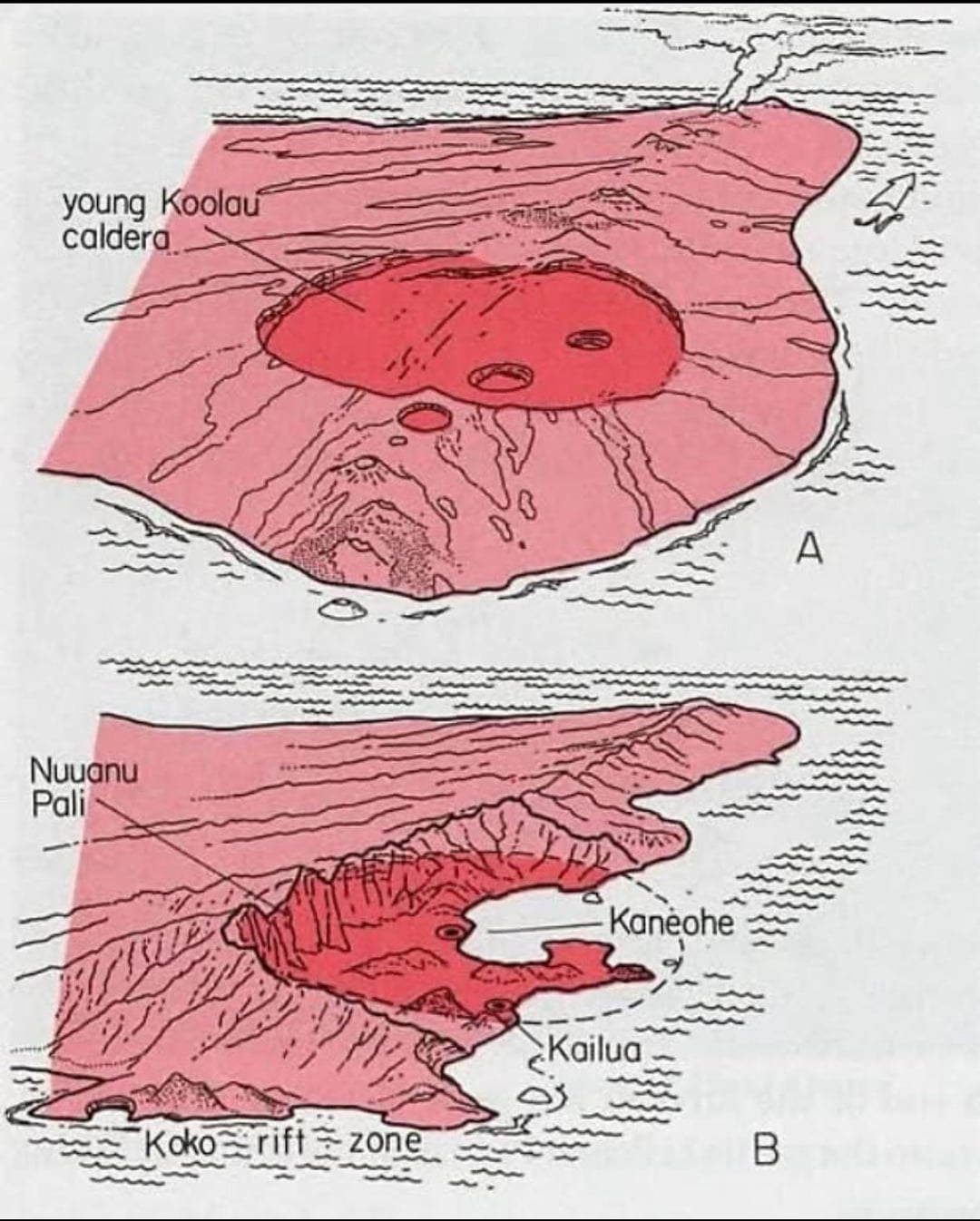
Diagram by Iain Cameron, reproduced with credit.
Sources: Ocean Drilling Program: Nuʻuanu Landslide, Morgan et al. on Tuscaloosa Seamount, Reuters on the Nepal-China border floods.